

The craft of the cutter: where the quality of a bag begins
The cutter reads grain, veins and strength in the leather before every cut. One of the central skills of leather craftsmanship, explained.
In this article
- Reading the leather
- Every part of the bag needs a different area
- Precision and respect for the material
- Hand, tools and technology
- Skiving and preparation
- A knowledge built over time
- A reading made with the eyes and with the hands
- Reducing waste without reducing quality
- The work that keeps making itself felt
- Learning to tell uniformity from quality
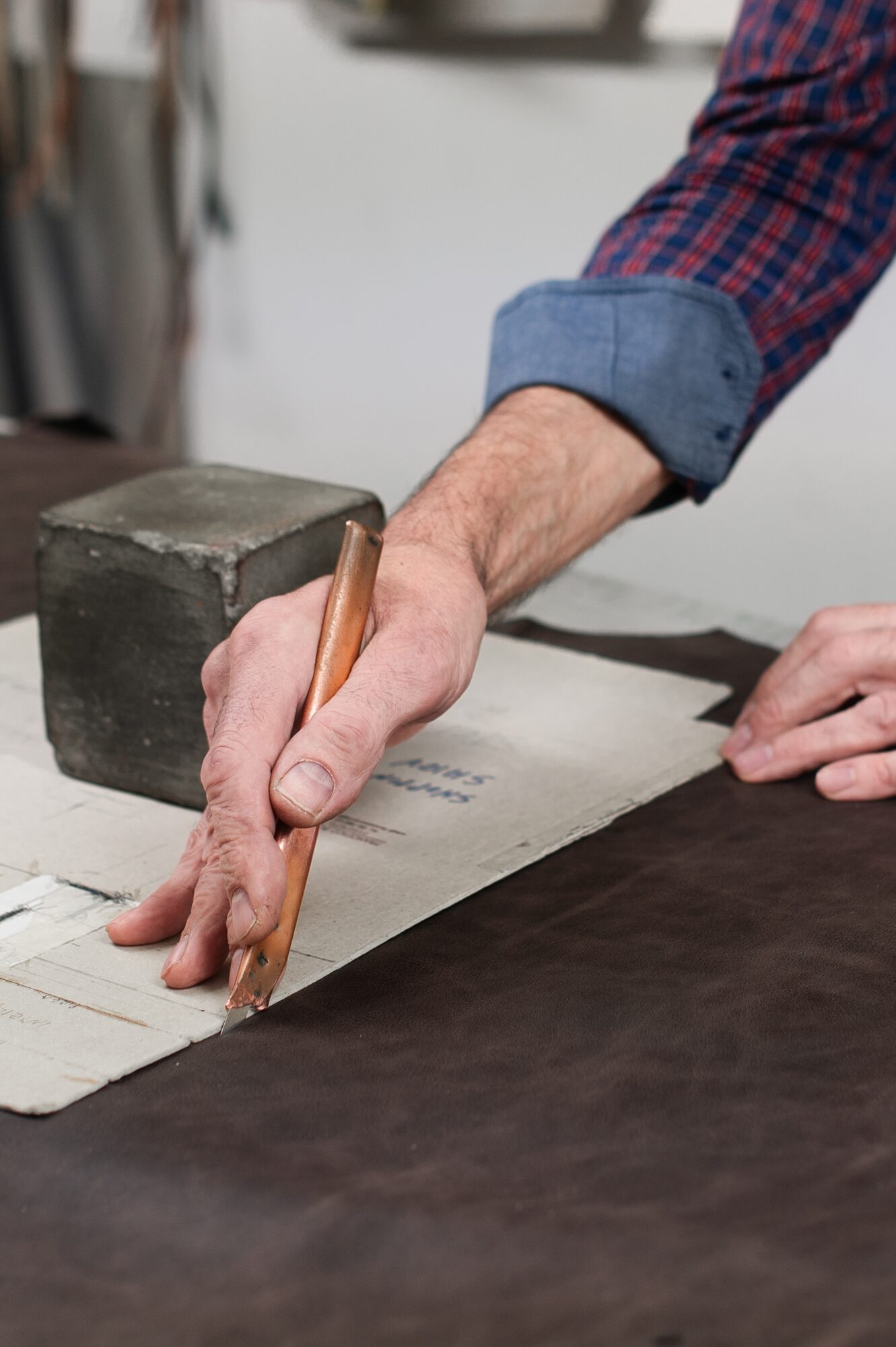
Before cutting, you have to look. A hide is not a uniform sheet produced in series: every surface has differences in grain, elasticity, thickness and colour. The cutter’s task is to understand them and to assign each area the function it suits best.
In the silence of the cutting table one of the most irreversible decisions of the whole craft is made. As long as the hide is whole, many possibilities stay open; after the first cut, every element has been given a position and a destiny. Speed is therefore not the first value. Attention comes first, then knowledge of the model and the ability to imagine how each piece will behave in the years to come.
Reading the leather
The cutter lays the hide out and looks at it with a light that brings out its surface. He touches it, checks its consistency and its direction, recognises the most compact areas and the most elastic ones.
Small natural marks are not necessarily defects. They may testify to the authentic origin of the material. The skill lies in understanding which characteristics can be enhanced and which, on the other hand, must not end up on a visible or structurally important part.
Every part of the bag needs a different area
The bottom and the handle attachments take more strain than an inner pocket. The front panel needs visual continuity; a part meant to fold has to keep enough flexibility.
Laying out the patterns therefore means building a map. The cutter is not simply trying to fit as many pieces as possible onto the hide: he relates the qualities of the leather to the needs of the design.
Precision and respect for the material
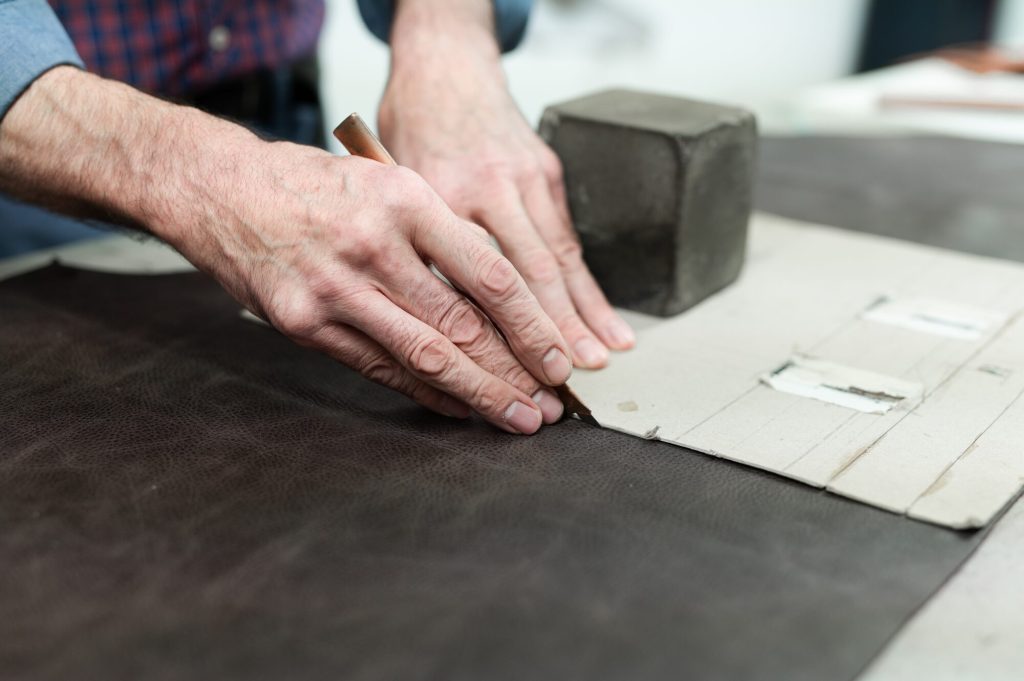
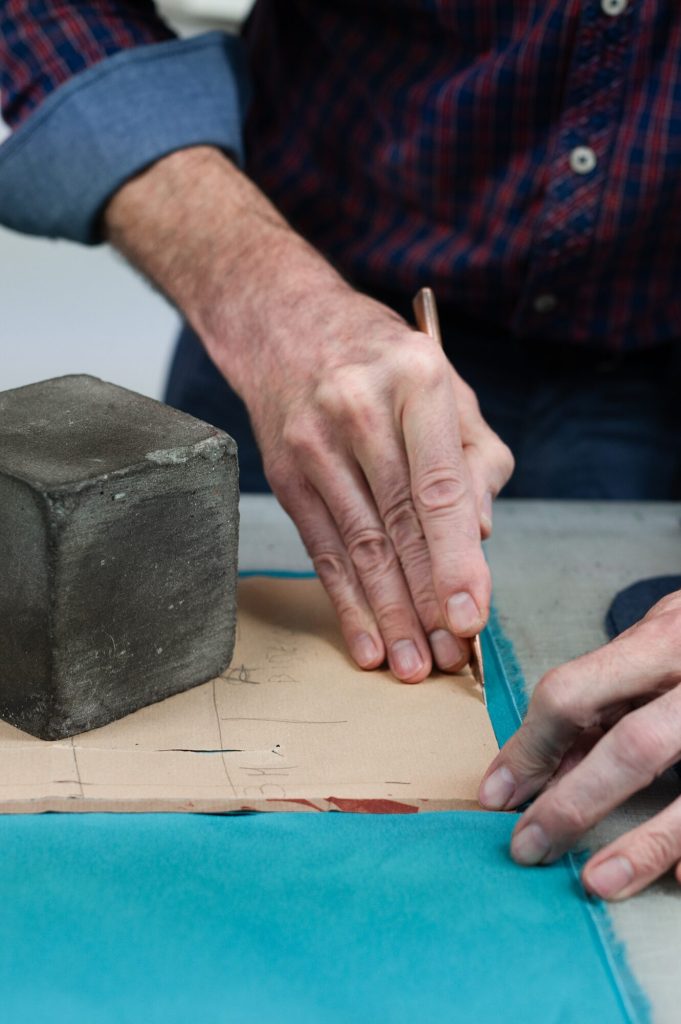
The cut has to follow the profile with absolute precision. Curves, corners and reference points will determine the alignment during assembly. An inaccuracy of a few millimetres can become obvious when two pieces are placed on top of each other.
At the same time, intelligent placement reduces waste. In real artisanal practice quality and responsible use of the material are not opposing goals: both depend on knowledge.
Hand, tools and technology
There are tools and machines that speed up cutting, but the human eye remains essential when working with natural leather. An automatic system can follow a line perfectly; it cannot always decide whether a vein should become part of the character of the front or be destined for a less visible element.
In the artisanal workshop the tool is guided by experience. The value does not lie in refusing technology, but in being able to use it without giving up judgement.
Skiving and preparation
After the cut, some areas are thinned. This operation, called skiving, allows the leather to fold or overlap without creating excessive thickness. It calls for control: removing too much weakens the piece, leaving too much makes a seam heavy or a fold rigid.
Marking out, edge preparation and the marking of the points where reinforcements, fittings or linings will be inserted come next.
A knowledge built over time
The cutter’s craft cannot be learned from written rules alone. You have to see many hides, compare the material before and after working, and watch how a decision behaves during assembly and use.
This experience explains why cutting is one of the first real guarantees of quality. Before the bag even takes shape, someone has already decided which parts of the material will bear time, weight and movement.
A reading made with the eyes and with the hands
Raking light makes the grain visible, the hand perceives differences in consistency, and a slight flex shows how the surface reacts. With experience the cutter also recognises the direction in which a piece will give way more easily. He is not sorting the leather into perfect and imperfect zones: he is building a hierarchy of possible uses.
A successful bag also depends on coherence between neighbouring elements. Two sides have to react in a similar way; parts placed side by side on the front should not show random changes of colour or grain; the attachments have to have compatible strength. The cutter thinks about the single piece and, at the same time, about the whole that does not yet exist.
Reducing waste without reducing quality
Reducing waste does not mean squeezing the patterns together while ignoring the nature of the hide. It means finding a smart arrangement, sending the less suitable areas to small details that can take them and keeping what may be useful in other workings. Respect for the material is measured in the ability to use it well, not in the abstract promise to waste nothing.
This balance also avoids a simplistic opposition between hand and machine. A die guarantees repeatability, while hand cutting offers freedom and adaptation; a digital system can help organise the shapes, but the eye keeps evaluating a natural surface. Quality comes from choosing the most suitable tool and from the responsibility of the person using it.
The work that keeps making itself felt
Many customers see the result without imagining this hidden geography. Yet when a bag keeps its shape, when the handles hold and the surfaces age with balance, part of the credit belongs to the decisions taken on the cutting table. The cutter’s craft stays discreet precisely because its best work merges into the object and keeps working without making itself noticed.
Learning to tell uniformity from quality
Industrial production has trained the eye to expect perfectly identical surfaces. Faced with natural leather, a slight difference in tone or a variation in the grain can be mistaken for a problem, even when it simply testifies to the nature of the material. The workshop’s task is not to celebrate every irregularity, but to distinguish what gives character from what could compromise looks or durability.
The cutter makes this distinction before the customer can see it in the finished product. He decides which marks can enter the story of the bag and which must be excluded or placed elsewhere. Artisanal quality is therefore not the search for an abstractly perfect leather: it is born from the ability to select and compose real differences into a harmonious whole.
This is why two bags made from the same paper pattern and in the same colour will never be completely identical. They will share proportions, construction and quality standards, but each will keep its own shades. It is not a lack of control: it is the result of a control experienced enough to work with the nature of the leather instead of cancelling it out.
Where the work continues
The rest of the journey is told in how an artisanal leather bag is made and in how a bag is designed. At the historic Bojola boutique in Florence you can watch leatherworking up close, and see the result in the bags in the shop.