

Come viene realizzata una borsa in pelle artigianale: dal disegno all'ultima cucitura.
Dal disegno alla scelta della pelle, dal taglio alla cucitura: ecco come nasce una borsa artigianale nella tradizione fiorentina.
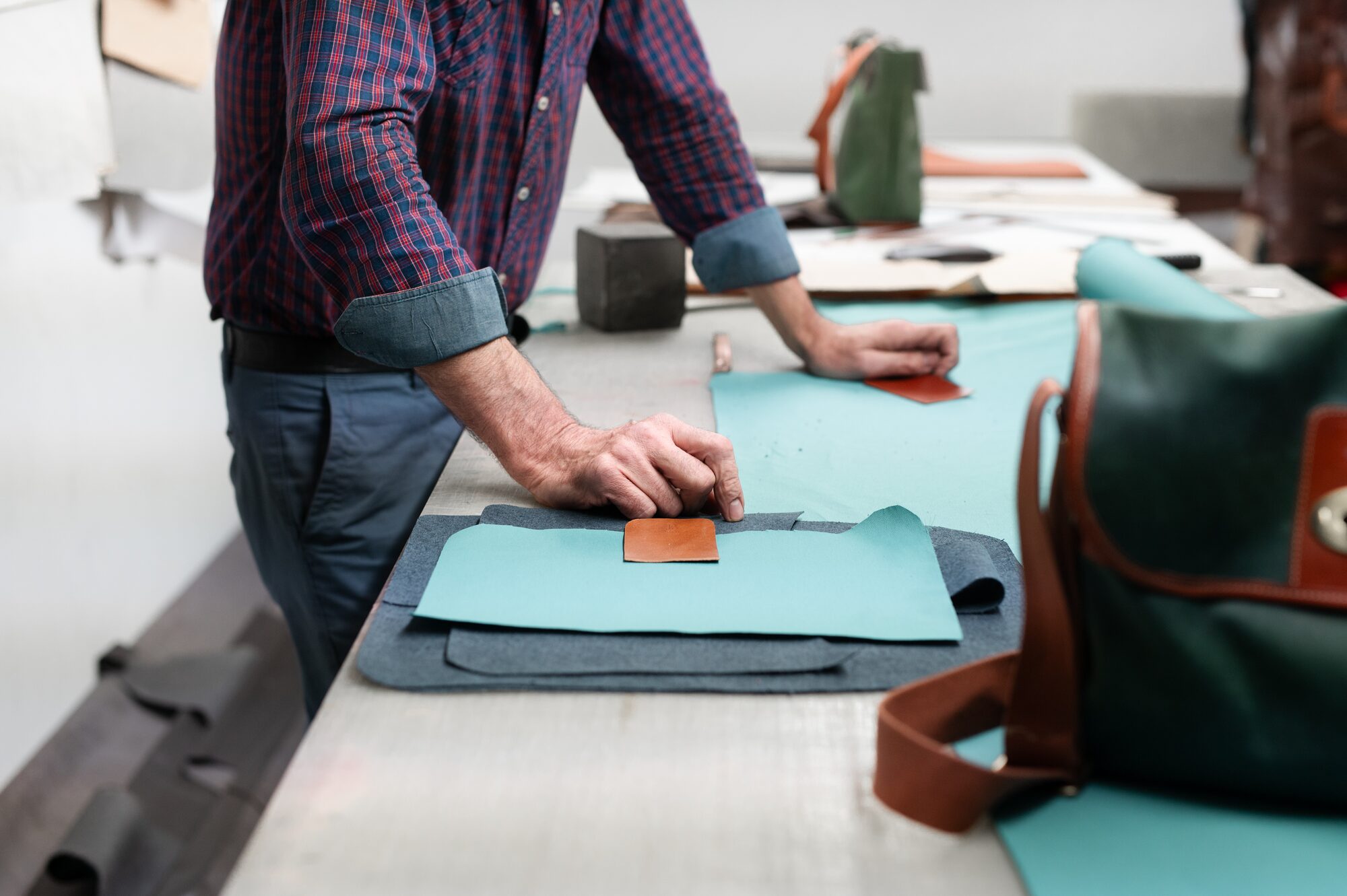
In questo articolo
An artisanal bag is not born when the leather meets the needle. It is born earlier, often on a blank sheet of paper, when an idea is turned into lines, volumes and proportions. Only then does the workshop begin: a sequence of different gestures, entrusted to people who know the material and know how to read it.
In a Florentine leather workshop every stage has a precise role. The drawing establishes the character of the object; the paper pattern translates its shape into elements that can actually be made; the choice of leather determines how it behaves and how long it lasts; cutting, preparation, assembly and stitching finally give the bag its three-dimensional structure.
From the outside a bag can look like a simple object: a volume, two handles, a closure. Inside the workshop that simplicity is the result of many coordinated decisions. Changing the angle of a side by a few millimetres, or the point where a shoulder strap is attached, is enough to change the balance, the comfort and the way the model is carried. This is why artisanal workmanship does not coincide with one spectacular technique, but with continuity of attention from beginning to end.
1. It all starts with the design
Before the material comes the function. What will the bag have to hold? How will it be carried? What weight will it need to support? How far should it open, and which objects have to be easy to reach?
The drawing is not only about the outside. It sets the relationship between height, width and depth, the position of the pockets, the length of the handles and the type of closure. A shape that is elegant but uncomfortable is not a good design; in the same way, functionality alone is not enough to create an object meant to accompany us for years.
In the Bojola tradition the design comes from a balance between aesthetics and use. The lines are meant to last beyond a season, and the construction has to respect the natural behaviour of the leather.
2. From the drawing to the paper pattern
The paper pattern breaks the bag down into its elements: front panel, back, bottom, sides, flap, pockets, handles and reinforcements. Each part is drawn at its exact size, with margins for stitching, folds and thickness in mind.
It is a phase much like architecture. Even a few millimetres can change the way a flap closes or the way a seam meets the edge. Before the final leather is cut, a prototype can be made to check the volumes, the proportions and how the bag actually works.
3. Choosing the leather
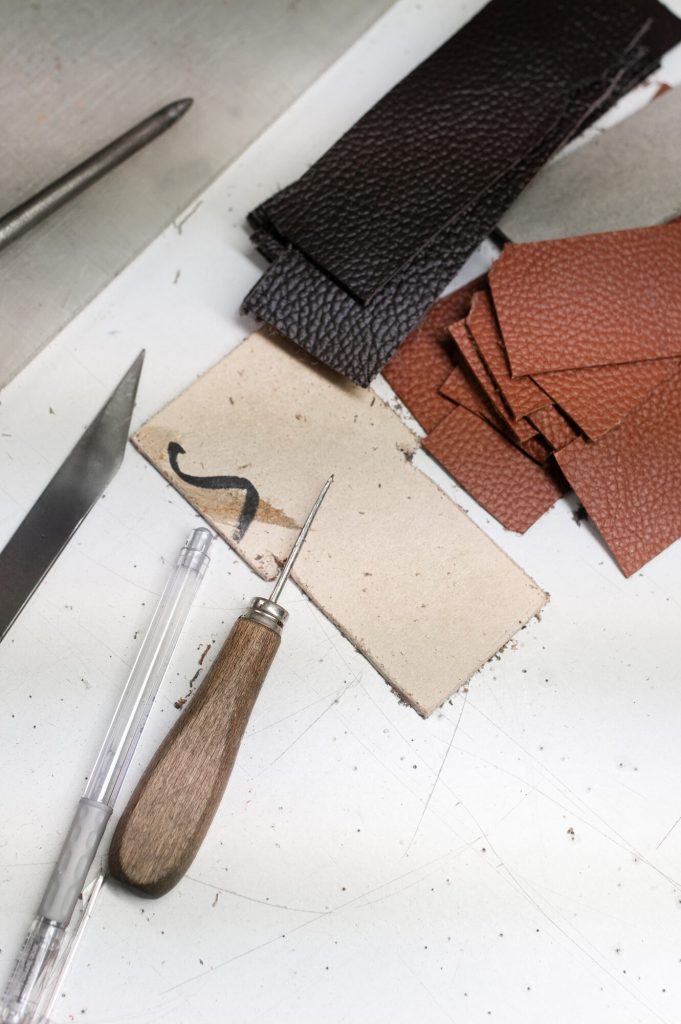
Not every part of a hide has the same characteristics. Some areas are more compact and resistant, others softer or more elastic. Veins, changes in grain and small natural marks tell the story of the material, and they have to be read with care.
The type of leather is chosen according to the model. A structured bag requires a different behaviour from a soft shoulder bag. Vegetable-tanned cowhide, for instance, is valued for its strength, the depth of its colour and the patina it develops with use.
4. The cut
The cutter lays the patterns out on the hide, looking for the most suitable spot for each element. The parts that will be worked hardest come from the most compact areas; the visible ones need continuity of colour and grain.
Cutting well also means using the material with respect, limiting waste without giving up quality. Precision is essential: a mistake at this stage cannot be corrected by a later seam.
5. Preparation and assembly
Edges can be thinned where the leather has to fold or overlap. Reinforcements, linings, pockets, zips and metal fittings are prepared. Then the individual elements are brought together, held temporarily and assembled.
This is the moment when the bag leaves the flat surface and gains volume. The artisan’s hand guides the leather, avoiding unnatural tension and keeping an eye on symmetry throughout.
6. The stitching
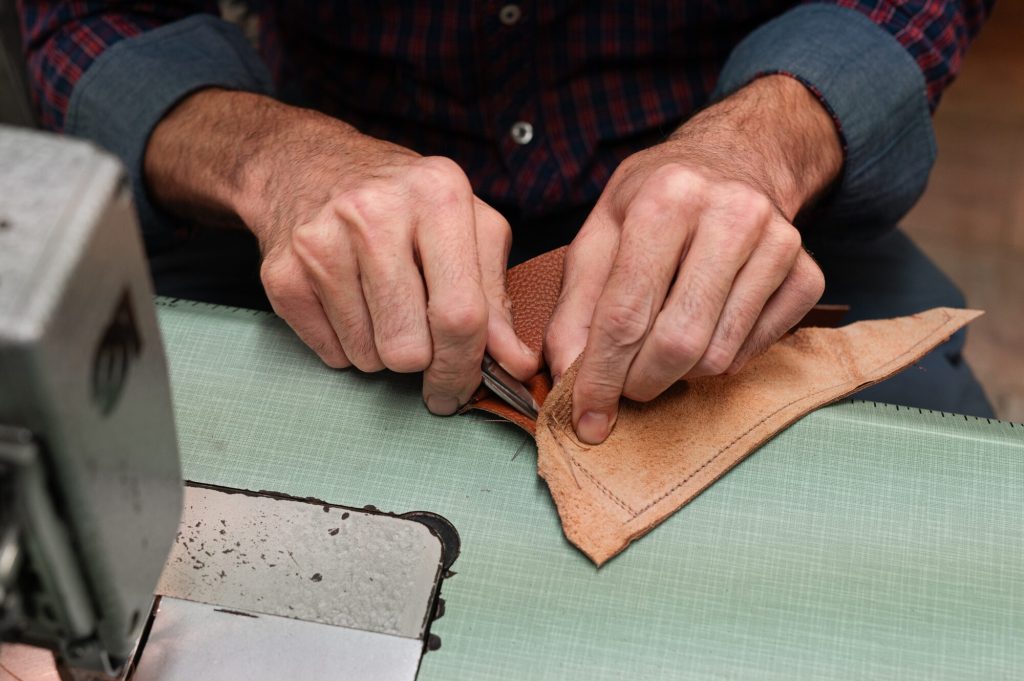
In an artisanal workshop the sewing machine does not replace the sensitivity of the person using it. The artisan guides the material, adjusts speed and tension, follows curves and changes of thickness. The distance from the edge has to stay consistent, and the stitches must hold the structure without stiffening it unnecessarily.
Some operations and finishes are carried out by hand, above all where particular control or precision is needed.
7. Inspection and finishing
Before it leaves the workshop a bag is looked at from every side. The opening and closure, symmetry, seams, edges, buckles, zips and the cleanliness of the inside are all checked. The aim is not an artificial uniformity: natural leather always keeps slight differences. What is verified is that every detail works and that the whole expresses the intention of the design.
The value of time
An artisanal bag is the result of different skills converging on a single object. Behind an apparently simple line there can be many decisions: the direction of the cut, the thickness of an edge, the position of a reinforcement, the length of a shoulder strap.
It is this invisible attention that makes a bag pleasant to use today and able to accompany us over time.
The object is designed for real life
The design takes into account everyday gestures that are often unconscious. A bag is set down on the ground, opened with one hand, filled more than expected, carried with a coat or with light clothes. The designer imagines these situations and looks for a shape able to face them without losing harmony. Good design is recognised precisely when the solution seems obvious: a pocket is where the hand looks for it, the flap opens without obstruction and the weight stays close to the body.
The prototype then gives back information the drawing cannot. It shows whether the bag keeps its balance when it is set down, whether the opening is wide enough and whether the interior depth is really what was imagined. It is also the moment when the people in the workshop can compare notes: whoever will cut the leather or assemble the bag sees different problems and possibilities from whoever drew it. This conversation between design and craft is one of the most important differences between a simple idea and a well-made product.
The hidden quality
Many steps will not be visible once the work is finished. Some edges are thinned so that nothing builds up, certain areas receive a reinforcement and the lining is adapted to the internal shape. These are hidden choices, but they affect the way the bag opens, keeps its profile and faces daily use. A well-resolved construction should not look complicated: it has to work naturally.
The final check goes beyond appearance too. The bag is opened, set down, lifted and sometimes filled, because an object designed for everyday life has to be judged in motion. A zip can look perfect and yet not run with the fluidity we want; a handle can be well stitched and still ask for a more comfortable grip. The last verification brings the work back to the original question: does this bag do well the job it was created for?
A bag keeps changing
Over the years the work of the workshop keeps showing through. The points of greatest contact become softer, the leather takes on a personal patina and the volume adapts to the habits of whoever carries it. A well-made bag does not stay still: it changes without losing its identity. That may be the most concrete meaning of craft — creating an object solid enough to cross time and alive enough to tell it.
Come and see leatherworking up close
At the historic Bojola boutique in the centre of Florence, the From Hide to Heritage experience brings you close to the material: you can watch a demonstration and personalise a leather object. Discover From Hide to Heritage, or browse the bags made in our workshop.
This article is the first of a series: in the next ones we follow the drawing as it becomes a paper pattern and the craft of the cutter, who decides where the quality of a bag begins.